Altcoins are one bet, and niche coins are a lottery
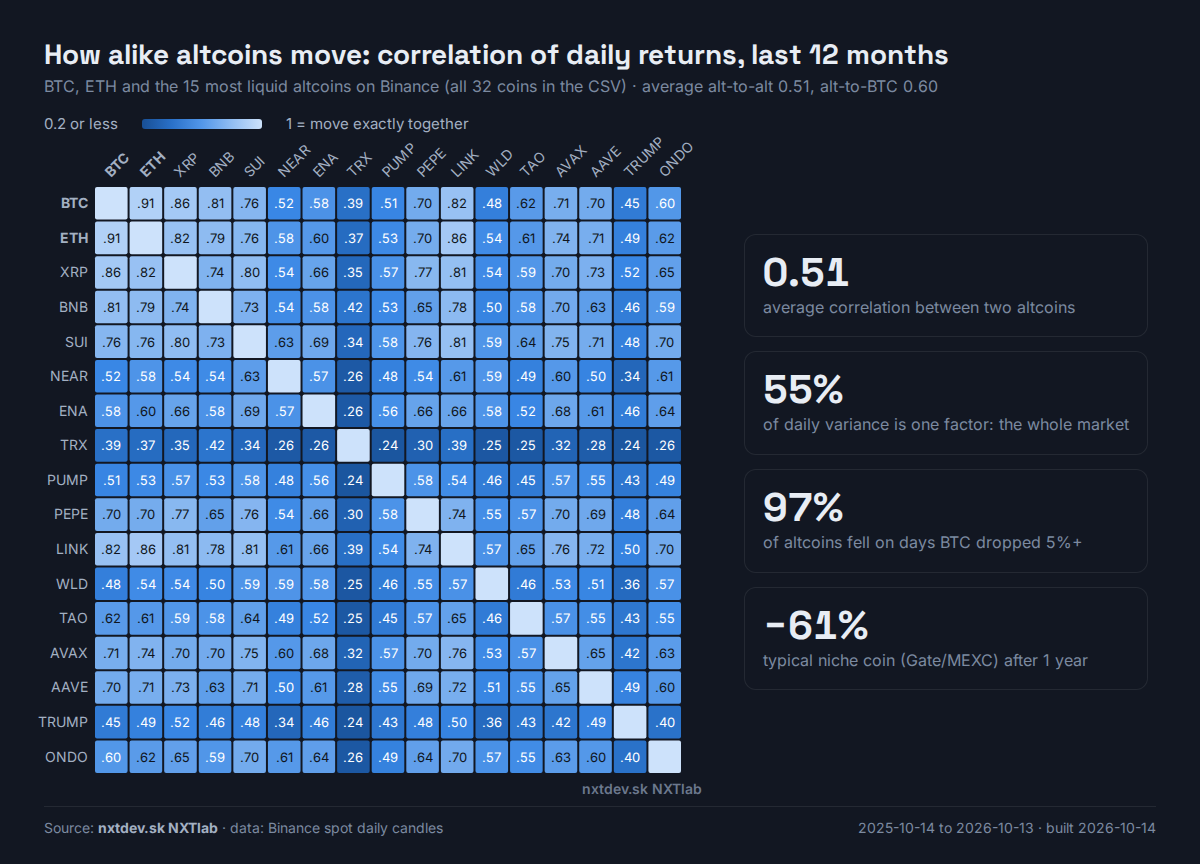
Owning 30 altcoins is not 30 bets. Most of what any alt does on a given day is the whole crypto market moving, and on BTC's bad days almost every alt falls with it. Below the big names, among 1,143 coins listed only on Gate and MEXC, a handful of big winners keep the average return near zero, while the typical coin loses most of its value.
How alike altcoins move: correlation of daily returns, last 12 months
Correlations measured within each group of days. Picking days by BTC's move narrows BTC's range, which pulls any correlation with BTC down by construction; read the return columns.
Average correlation of daily returns, by calendar year
Each year: the 20 alts with the highest median daily volume in that year, delisted coins included
Niche coins: buy any day, hold, and see what happens
Survivorship bias makes these numbers too good. Gate only shows coins that still trade, and MEXC shows few of the dead ones. Coins that died are missing, so the niche returns below are upper bounds and the drawdowns lower bounds. The Binance group includes delisted coins and is the fairer picture.
Return of buying on a random day and holding, by group
5th to 95th percentileMedian (typical outcome)Mean (expected value)
Max drawdown is the worst fall from an earlier high, on daily closes, over each coin's history in the window. BTC's worst over the same years was .
The 40 most liquid niche coins, one by one
Holding returns over each coin's own history in the window (overlapping windows, so a short history rests on one or two market phases). Empty = history too short.
Volatility, beta and correlation to BTC for all 32 coins
Correlation and covariance: daily close-to-close returns of BTC, ETH and the 30 altcoins with the highest median daily volume on Binance over the last 90 days that traded through the whole last year. Stablecoins, wrapped and tokenized assets are removed. Covariance and volatility are annualized (×365 days). Choosing coins by today's volume does not flatter a correlation the way it flatters returns.
One factor: principal components of the standardized daily returns. The first component is the market moving together.
Crash days: since January 2022, every day BTC closed 5% or more lower.
Niche coins: crypto pairs on Gate and MEXC that never traded on Binance, May 2022 to October 2026. A coin listed on both counts once. "Tradable" = median daily volume of at least $200k over the coin's history. That rule looks at the whole history, so it favours coins that became popular, which is one more reason the niche numbers are upper bounds.
Holding returns: buy at a daily close, sell 30, 90 or 365 days later, from every possible start day. Each coin weighs the same however long its history, so the pooled numbers answer: a random coin, bought on a random day. Returns are for the holding period, not per year, and before fees and slippage.